- Welcome
- About
- Library
- Elections
- News
- Campaigns
- Standing Campaigns
- VIC: Oppose the Victorian Government Attack on Associations Representing Workers
- Stop Labor’s Digital Duty of Care — it’s a Trojan Horse for censorship
- A Baby Born Alive Deserves Protection
- The Hidden 35, What Albanese Won't Tell You
- TAS: Let Tasmanians Speak
- Governor-General Has Taken Sides
- Stop the Malik Report
- Don't Cancel Captain Cook
- Labor Wants to Strip a Christian Church of Its Charity Status
- Thank the Coalition for Defending Christian Schools
- Tell MPs: Reform the Broken Sex Discrimination Act
- Tell Jim Chalmers: Stop the Reckless Spending
- Tell the Premier & Education Minister: No Teaching about Bestiality at School
- Thank Robbie Katter for Defending our Flag
- Your Home, Your Rights: Back Castle Law
- Thank Nigel Dalton for his vote to protect babies
- URGENT: Demand Justice for Baby Samuel!
- Reform Parliamentary Travel Entitlements
- Thank Tim Nicholls for Reinstating the Puberty Blocker Ban
- Stop Late-Term Abortion Bill: Protect Employers from Funding Abortions
- Thank NT Chief Minister Lia Finocchiaro for banning gender-confused men from women’s prisons
- Urgent — Help Stop the Surrogacy Bill 2025
- Tell Jacinta Allan: Stop Protecting Sex Offenders
- We stand with Jacinta Price
- Call on Lia Finocchiaro to Protect Christian Schools
- Thank Amanda Camm for Standing Up for Women
- Tony Burke’s Double Standard: Silencing Voices, Welcoming Extremists
- Thank Andrew Hastie for Defending Our Flag
- Tell the Albanese Govt: Stop Paying Women for Killing Their Babies
- Thank Senator Antic for Standing Up for Truth
- Tell the Melbourne Royal Show: Stop the Bible Ban
- Ask Health Minister Mark Butler: What are you doing to stop sex-selection abortion?
- Protect the Blood Supply – Keep the Ban on Gay Men Donating
- Tell the Liberals: Support Income Splitting for Families
- Tell The Nationals: Scrap Net Zero
- Tell Sussan Ley: Save Women’s Sport
- Thank Senator Henderson and the Coalition for Opposing University Indoctrination
- Tell Jim Chalmers: Drop the Woke $5 Note and Keep the Monarchy
- Thank Qantas Chairman John Mullen for Rejecting Corporate Wokeness
- Thank the NT Government for Protecting Free Speech and Religious Freedom
- Tell Chris Minns: Defund the Offensive Mardi Gras
- BREAKING NEWS! Midwives are being turned into abortionists
- Protect Our Schools from Political Activism
- Axe the Daniel Andrews Statue
- Thank the QLD Premier and QLD Health Minister
- Tell Premier David Crisafulli: Stand for Democracy in QLD – Restore the Right to Debate
- Emergency: Tell Key Senators to stop ‘Digital Prison’ Misinformation Bill
- Thank Peter Dutton for Commitment to Stand United Under One Flag
- Thank QLD Premier for Scrapping the “Truth-telling” Inquiry
- Where is the Honour and Respect for our King?
- Thank Toyota for Ditching Sponsorship of LGBT Parades and Events
- Protect Free Speech: Stop the Misinformation Bill
- Tell the AFL: Axe the ‘Welcome to Country’
- Tell Jim Chalmers: Don’t Ask Creepy Sex Questions on the Census
- Tell Jacinta Allan: Stop Radical Gender Indoctrination in Libraries
- Urgent Action On Babies Born Alive
- WA: Hit pause on dangerous gender self-ID bill
- A Fair Go for Families in Education
- Tell the Australian Olympic Committee: Ensure Respect for Christianity at the 2032 Brisbane Olympics
- Stop the Dangerous New “Human Rights Act”
- Stop Government-Mandated Radical Doctrines in Childcare
- Thank Bill Shorten for No More Prostitutes on the NDIS
- Repeal the Digital ID Bill to Protect Our Freedoms
- Tell the ADF: Stop the woke garbage and get serious about defending our nation
- Ask the Nationals to Support the Family with Income Splitting
- NSW: Stop the Inequity Bill
- Demand Answers from Labor MP Aaron Harper on the Babies Born Alive Bill Inquiry delay
- Defund the ABC over ‘racist country’ smear
- Tell the Premier and Opposition Leader: Keep Art Galleries Safe for Children
- Protect the rights of Biological Females
- Thank Cumberland City Council for Upholding Community Standards
- Tell Anthony Albanese the Bishop says Keep Free Speech
- Thank WA Liberals for ban on transgender drugs for kids
- Thank Anthony Albanese for his strong stand on Religious Freedom
- Thank Sarah Game for bill to prohibit gender ideology
- Thank the Opposition Leader and tell the Premier: Stop the Divisive Voice
- Tell the Premier & Education Minister: Kids should not be learning about bestiality at school
- Thank Archbishop Fisher for standing up for faith-based schools
- NSW: Tell NSW MPs: Oppose the flawed ‘Conversion Practices’ Bill
- Tell Peter Dutton: Protect Christian Schools
- Tell Mark Dreyfus To Keep Protections For Christian Schools
- Tell the PM & Opposition Leader: Protect Kids from Porn
- Tell Adelaide United: Free soccer star Musa Toure
- 27 WA Babies Cry Out From Their Graves
- Stop the Clandestine Censorship
- Keep the Monarchy on our $5 note
- Defund the ABC over Drag Queen activism
- VIC: Tell Victorian MPs: Keep the Lord’s Prayer!
- Hands Off Christian Schools
- Thank Peter Dutton for standing up for Australia Day
- Tell the PM: Stop the woke attack on Australia Day
- Thank the Coalition for their Policy to Keep Children Safe
- Tell the SA Premier: Hands off Anzac Day!
- Say No to Mutilating Healthy Body Parts
- Thank the ICC for banning gender confused men from women’s cricket
- Defend Religious Freedom In WA
- Thank Senator Antic for his bill to prohibit childhood gender transitions
- Federal babies bill must be voted on!
- Tell the Premier and Oppositiona Leader: Respect the Referendum - Repeal the SA Voice
- Thank Peter Dutton for calling for a proper Covid-19 inquiry
- Thank Peter Dutton for taking a stand against Hard Drugs
- Thank the AFL Commission for sticking to footy
- WA: Oppose the Deceiving WA Abortion Bill
- WA: Scrap The Shambolic Cultural Heritage Act
- Protect Children from Daycare Monsters
- Protect Unborn Children
- Tell MPs: Protect Freedom of Speech – Oppose the ACMA Disinformation Bill 2023
- Tell the PM: Protect Religious Freedom – Save Calvary Hospital
- Thank Monash council for cancelling drag queen story time
- Tell the Melbourne Comedy Festival: Reinstate Barry Humphries’ award
- Thank Dennis Hood, Sarah Game and Frank Pangillo for opposing woke language push
- Urge the PM to sack the Classification Board
- Support Henry Pike’s Bill to Save Australia Day
- Keep Moira Deeming MP in the Liberal Party
- Tell Adelaide City Council: Keep the Opening Prayer
- Thank the NRL for saying NO to gay ‘Pride Round’
- Tell Ch 10: Axe The Project over disgusting Jesus joke
- Tell the PM & AG: Protect the best interests of children
- Thank SA Libs for stand against the Voice to SA Parliament
- Thank Church Leaders for Protecting Christian School
- Protect Christian Schools
- Tell Albo: Keep your politics off the $5 note
- Thank Peter Dutton for No Blank Cheque on The Voice
- QLD: Do not attack parent rights and school choice
- Thank Senator Jacinta Price for opposing the divisive ‘Voice’
- Tell Mosman Council: Don't cancel Christmas!
- Thanks for Protecting Freedom of Speech
- Tell the SA Premier: Keep the Lord’s Prayer
- SA: Hands off the Lord’s Prayer
- NT: Stop attack on faith schools in the NT
- Keep using Mother and Father
- WA: Stop Zero Oversight To WA Emergency Powers
- Victoria – the Anti-Christian State
- WA: Defend Religious Freedom In WA
- Thank Anthony Albanese for keeping the Monarchy on our money
- Thank the Australian Catholic Bishops Conference for standing up to gender ideology
- QLD: Sophie's Law - Does the Queensland Government have a heart?
- Thank UAP Senator for standing up to radical identity ideology
- Stop abortion attack on religious hospitals
- Ask Albanese: When will you deliver $275 power bill cut?
- Stop the Killing in the Territories
- Keep opening the Senate with the Lord’s Prayer
- Coalition’s refreshing new voice of truth
- Tell the Manly Sea Eagles: Stick to footy - Ditch the LGBT propaganda
- Keep Christmas Day For Jesus
- Save Freo from “All Ages Drag Show”
- Tell MPs: We need a National Strategy to safeguard babies
- Say No to giving our Sovereignty away
- Say No to changing Birth Certificates in QLD
- Tell the woke NSW Premier: Keep the NSW flag – ditch the identity politics
- Introduce Miles Law to Protect Life in QLD
- QLD: Holding the QLD Premier to Account
- VIC: Andrews government divides children
- Adam Bandt disrespect for Australia, Australians and our Flag
- Keep Christian Chaplains in Schools
- Albanese to Ditch the Queen
- Keep Doors on School Toilets
- Tell the Breastfeeding Association: Do not cave to woke trans ideology
- Keep Blokes out of Women Sport
- Keep Australian Children Safe from Harms
- Mr Morrison - Can you help?
- Defund the UN over extreme abortion and gender ideology stance
- Tell Anthony Albanese: Protect Children from Trans Activists
- Protect Australians: Say no to hard drugs
- Stop Big Tech from Silencing Australians
- Tell MPs: Save Women’s Sport
- Time to Deliver on Religious Discrimination
- End Discrimination based on COVID19 Vaccination Status
- VIC: Act now to save Christian schools’ right to employ
- Tell MPs: Protect Free Speech
- Have your say in stopping kids’ access to online porn
- VIC: Act now to stop prostitution being decriminalised
- The ABC needs fixing
- WA: Free to Change: Stop McGowan’s therapy ban
- VIC: Act now to stop a second failed drug-injecting centre
- Act now to stop trans drugs for children
- Act now to stop Patten’s reckless changes to vilification laws
- Born Alive Bill
- Gambling Campaign
- Past Campaigns
- Events
- Contact
- 365Life
- Mother of the Year Awards
- Media Releases
- Little Music Church
- Australian Christian Man of the Year Awards

YOUR GUIDE TO CURRENT ISSUES ON FAMILY, LIFE AND SOCIETY
 Donate
 Subscribe to our weekly newsletter to be kept up to date with the work FamilyVoice Australia is doing in our nation 
-
Home

- News
News

A legal group has filed a lawsuit against the Governor of Washington over his COVID-19 order which penalises meetings of churches but allows marijuana and alcohol shops to operate.
Alliance Defending Freedom, which is representing Washington-based Christ’s Church of Mt Spokane, says the church does not have the staff or money to live-stream services.
The ADF is seeking an immediate halt to enforcement of the order which labels churches as “COVID-19 ‘superspreader’ events” and restricts church gatherings to fifty persons or a quarter of church capacity, whichever is less. Under the Governor’s plan restaurants can open at 50% capacity but churches are restricted to 25% or fifty persons, whichever is less.
“While responding to crises can be difficult, this case doesn’t need to be,” said ADF General Counsel Kristen Waggoner.
“The same Washingtonians who can be trusted to comply with social-distancing and other health guidelines in secular settings can also be trusted in religious settings.
“The Constitution simply doesn’t permit Gov. Inslee to assume the worst when people meet to worship but assume the best when those same people go to work, do some shopping, eat at a restaurant, or go about the rest of their daily lives.”
The church plans to adopt strict health and safety protocols, including encouraging the wearing of masks, spacing, and the use of hand sanitizer.
“Singling out churches for special punishment while allowing others to have greater freedom isn’t just illogical, it’s clearly unconstitutional,” said ADF Senior Counsel Ryan Tucker.
“Gov. Inslee has called cannabis retailers and breweries essential but prohibits pastors from ministering in-person to their congregations—a strategy that poses obvious constitutional problems. We support government leaders’ efforts to prioritize the public’s health and safety, but people of faith should be free to assemble if other groups are free to assemble.”
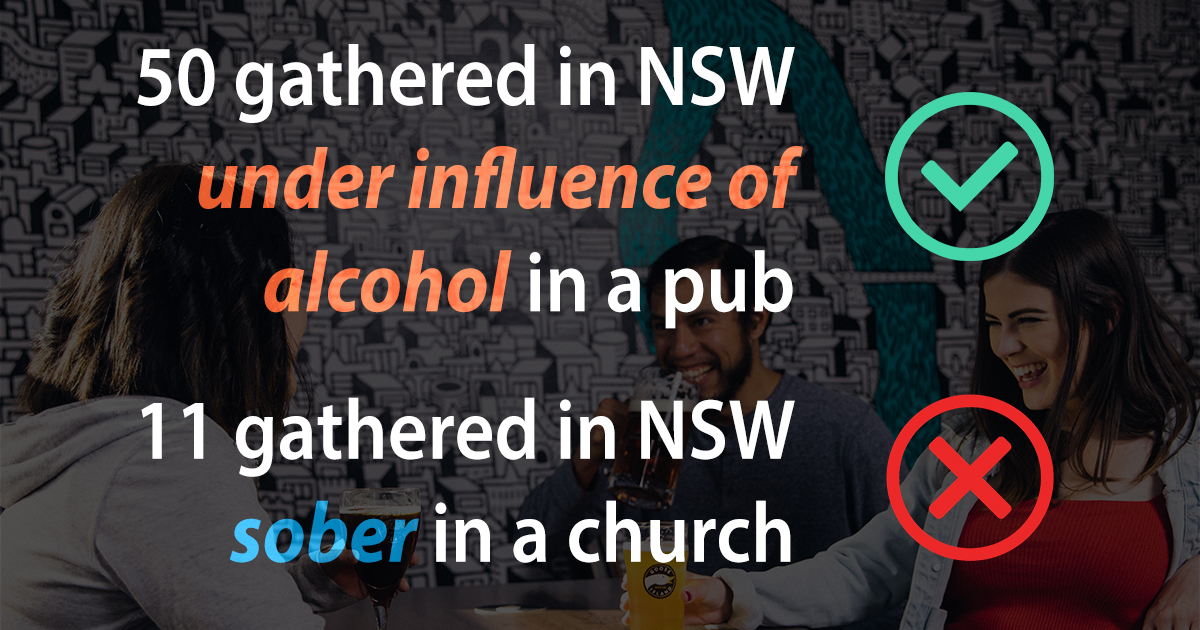
Pressure is building on NSW Premier Gladys Berejiklian to end her discriminatory COVID-19 church crackdown.
Over six thousand people have signed a petition launched by the Catholic Archdiocese of Sydney on May 27.
Presently in NSW fifty people can meet at hospitality venues. But as few as eleven people are prohibited from meeting at a church.
“Churches have cooperated at every stage with the Government’s public health directives during this pandemic,” Archbishop Anthony Fisher OP said.
“We understand that the shutdown was necessary to flatten the curve, but it came at a cost – not only to the economy, but also to the spiritual and mental health of our people.
“They miss gathering for worship and praying in a sacred space. I am at a loss to explain to Catholics in Sydney why our reasonable requests to the government are not being granted.
“Contrary to what has been said throughout this pandemic, we do not consider church attendance to be non-essential; indeed, nothing is more essential than the practice of our faith,” reads the petition.
“Catholics are not asking for special treatment, we are asking for equal treatment.
“This unequal treatment of religious worship leads us to ask whether the Government is listening to the concerns of Catholics and other people of faith or indifferent to the effect the closure of our churches is having on people during these difficult times.
“The freedom to practice faith is necessary for human flourishing and a great contributor to the common good.”
FamilyVoice Australia National Director Peter Downie said, “Governments have been heavy-handed and unjust in their treatment of churches during the COVID-19 crisis.”
A legal group has filed a lawsuit against the state of Oregon over a COVID-19 order which prohibits meetings at churches with 26 attendees.
The Alliance Defending Freedom says that it is also looking at putting a motion to temporarily restrain enforcement of the order pending the outcome of the lawsuit.
Under the order, pastors can be penalised with a fine of over $1,000 and jailed for up to a month.
The ADF says this is a double standard as the same number of people and more can eat in a restaurant without penalty.
“While responding to crises can be difficult, this case is not,” said ADF spokesman Caleb Dalton.
“There is no legitimate justification for banning church services of 26 or more—with responsible social distancing and health and safety protocols—while allowing malls, gyms, restaurants, and retail establishments to fill to social-distancing capacity.”
The church plans to adopt a number of health and safety measures when it re-opens to mitigate risk of the spread of the coronavirus.
“Singling out churches for special punishment while allowing others to have greater freedom not only makes no logical sense, it’s clearly unconstitutional, just as others have warned the governor,” said ADF Senior Counsel Ryan Tucker.
“Gov. Brown has had plenty of opportunity to correct the obvious constitutional problem with issuing a church-specific ban and has chosen not to.
“We support authorities’ efforts to prioritize the public’s health and safety, but people of faith should be free to assemble if other groups are free to assemble.”
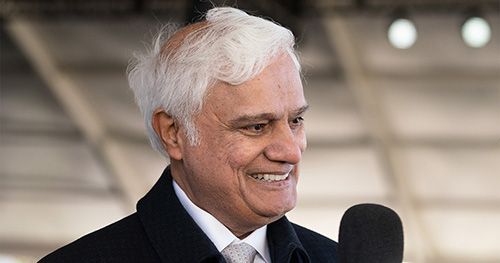
Last week the world lost one of its greatest Christian apologists, Ravi Zacharias.
Born in India, he died in the US aged 74 after a short battle with cancer – knowing that he would be going to join his Lord.
Ravi grew up in an Anglican family, but rebelled as a teenager. He became very depressed – to the point of attempting suicide.
But afterwards his life turned upside down. When he was recovering in hospital, a young Christian man explained the gospel to him. He decided to follow Jesus.
Ravi moved to Canada and later the US. He felt God calling him to share his faith with others – in all parts of society, but especially in academic and intellectual circles that tend to embrace atheism and mock Christianity.
Like the Apostle Paul, who argued for the Christian faith with philosophers and religious leaders in Athens and elsewhere, Ravi debated with university dons and students about the fundamental questions of life. They had no answers, but God did.
Ravi Zacharias is widely known for his lectures and more than 30 books. But one part of his resumé particularly interested me. He was one of the Christian leaders from across the world – Catholic, Protestant and Orthodox – who came together in New York in November 2009 to sign what was called the Manhattan Declaration.
This important document affirms key principles that FamilyVoice stands for. It says (in part):
In this declaration we affirm:
1) the profound, inherent, and equal dignity of every human being as a creature fashioned in the very image of God, possessing inherent rights of equal dignity and life;
2) marriage as a conjugal union of man and woman, ordained by God from the creation, and historically understood by believers and non-believers alike, to be the most basic institution in society and;
3) religious liberty, which is grounded in the character of God, the example of Christ, and the inherent freedom and dignity of human beings created in the divine image.
We are Christians who have joined together across historic lines of ecclesial differences to affirm our right – and, more importantly, to embrace our obligation – to speak and act in defense of these truths.
We pledge to each other, and to our fellow believers, that no power on earth, be it cultural or political, will intimidate us into silence or acquiescence. It is our duty to proclaim the Gospel of our Lord and Savior Jesus Christ in its fullness, both in season and out of season. May God help us not to fail in that duty.
And I say, “Amen!”
Peter Downie - National Director, FamilyVoice Australia
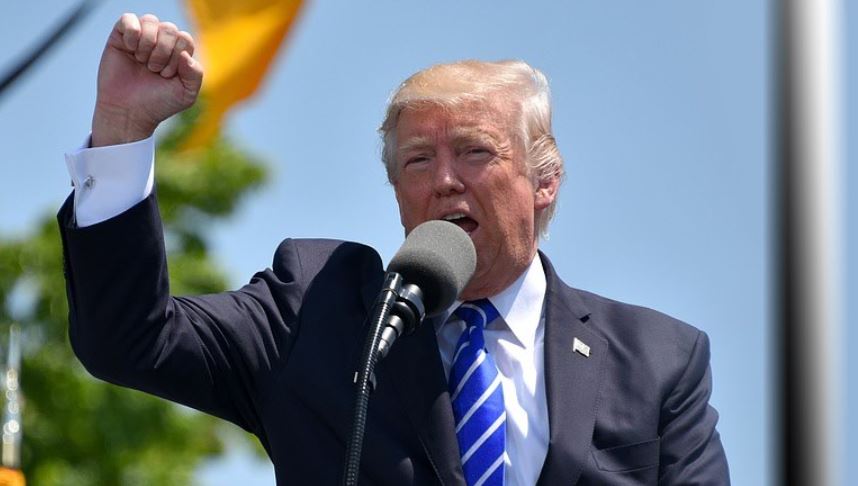
President Trump has announced a new policy that treats churches as “essential” during the ongoing coronavirus crisis.
“The governors need to do the right thing and allow these very important essential places of faith to open right now – for this weekend,” Trump said on Friday.
“If they don't do it, I will override the governors.”
Trump made the announcement, which will see churches treated as essential in new Centers for Disease Control guidance, at a briefing at the White House.
“In America, we need more prayer not less,” said Trump.
“Some governors have deemed the liquor stores and abortion clinics as essential but have left out churches and other houses of worship.
“It's not right. So I'm correcting this injustice and calling houses of worship essential.”
“The United States Department of Justice will continue to ensure that religious freedom remains protected if any state or local government, in their response to COVID-19, singles out, targets, or discriminates against any house of worship for special restrictions,” said Barr.
“Even in times of emergency, when reasonable and temporary restrictions are placed on rights, the First Amendment and federal statutory law prohibit discrimination against religious institutions and religious believers.
“Government may not impose special restrictions on religious activity that do not also apply to similar nonreligious activity,” Barr added.
Alliance Defending Freedom, a legal group which has filed a number of actions on behalf of churches targeted by state coronavirus orders, has called for churches to reopen commensurate with what is allowed for businesses and other groups.
FamilyVoice Australia upholds Christian values and the family: permanence of marriage, sanctity of human life, primacy of parenthood and limited government.
Subscribe to our award-winning publications!
Don't miss out on quality research and news that will equip you to face the culture wars.
Society is suffering from ‘progressive’ ideas.
Join the growing movement of young people daring to be counter-cultural.