- Welcome
- About
- Library
- Elections
- News
- Campaigns
- Standing Campaigns
- VIC: Oppose the Victorian Government Attack on Associations Representing Workers
- Stop Labor’s Digital Duty of Care — it’s a Trojan Horse for censorship
- A Baby Born Alive Deserves Protection
- The Hidden 35, What Albanese Won't Tell You
- TAS: Let Tasmanians Speak
- Governor-General Has Taken Sides
- Stop the Malik Report
- Don't Cancel Captain Cook
- Labor Wants to Strip a Christian Church of Its Charity Status
- Thank the Coalition for Defending Christian Schools
- Tell MPs: Reform the Broken Sex Discrimination Act
- Tell Jim Chalmers: Stop the Reckless Spending
- Tell the Premier & Education Minister: No Teaching about Bestiality at School
- Thank Robbie Katter for Defending our Flag
- Your Home, Your Rights: Back Castle Law
- Thank Nigel Dalton for his vote to protect babies
- URGENT: Demand Justice for Baby Samuel!
- Reform Parliamentary Travel Entitlements
- Thank Tim Nicholls for Reinstating the Puberty Blocker Ban
- Stop Late-Term Abortion Bill: Protect Employers from Funding Abortions
- Thank NT Chief Minister Lia Finocchiaro for banning gender-confused men from women’s prisons
- Urgent — Help Stop the Surrogacy Bill 2025
- Tell Jacinta Allan: Stop Protecting Sex Offenders
- We stand with Jacinta Price
- Call on Lia Finocchiaro to Protect Christian Schools
- Thank Amanda Camm for Standing Up for Women
- Tony Burke’s Double Standard: Silencing Voices, Welcoming Extremists
- Thank Andrew Hastie for Defending Our Flag
- Tell the Albanese Govt: Stop Paying Women for Killing Their Babies
- Thank Senator Antic for Standing Up for Truth
- Tell the Melbourne Royal Show: Stop the Bible Ban
- Ask Health Minister Mark Butler: What are you doing to stop sex-selection abortion?
- Protect the Blood Supply – Keep the Ban on Gay Men Donating
- Tell the Liberals: Support Income Splitting for Families
- Tell The Nationals: Scrap Net Zero
- Tell Sussan Ley: Save Women’s Sport
- Thank Senator Henderson and the Coalition for Opposing University Indoctrination
- Tell Jim Chalmers: Drop the Woke $5 Note and Keep the Monarchy
- Thank Qantas Chairman John Mullen for Rejecting Corporate Wokeness
- Thank the NT Government for Protecting Free Speech and Religious Freedom
- Tell Chris Minns: Defund the Offensive Mardi Gras
- BREAKING NEWS! Midwives are being turned into abortionists
- Protect Our Schools from Political Activism
- Axe the Daniel Andrews Statue
- Thank the QLD Premier and QLD Health Minister
- Tell Premier David Crisafulli: Stand for Democracy in QLD – Restore the Right to Debate
- Emergency: Tell Key Senators to stop ‘Digital Prison’ Misinformation Bill
- Thank Peter Dutton for Commitment to Stand United Under One Flag
- Thank QLD Premier for Scrapping the “Truth-telling” Inquiry
- Where is the Honour and Respect for our King?
- Thank Toyota for Ditching Sponsorship of LGBT Parades and Events
- Protect Free Speech: Stop the Misinformation Bill
- Tell the AFL: Axe the ‘Welcome to Country’
- Tell Jim Chalmers: Don’t Ask Creepy Sex Questions on the Census
- Tell Jacinta Allan: Stop Radical Gender Indoctrination in Libraries
- Urgent Action On Babies Born Alive
- WA: Hit pause on dangerous gender self-ID bill
- A Fair Go for Families in Education
- Tell the Australian Olympic Committee: Ensure Respect for Christianity at the 2032 Brisbane Olympics
- Stop the Dangerous New “Human Rights Act”
- Stop Government-Mandated Radical Doctrines in Childcare
- Thank Bill Shorten for No More Prostitutes on the NDIS
- Repeal the Digital ID Bill to Protect Our Freedoms
- Tell the ADF: Stop the woke garbage and get serious about defending our nation
- Ask the Nationals to Support the Family with Income Splitting
- NSW: Stop the Inequity Bill
- Demand Answers from Labor MP Aaron Harper on the Babies Born Alive Bill Inquiry delay
- Defund the ABC over ‘racist country’ smear
- Tell the Premier and Opposition Leader: Keep Art Galleries Safe for Children
- Protect the rights of Biological Females
- Thank Cumberland City Council for Upholding Community Standards
- Tell Anthony Albanese the Bishop says Keep Free Speech
- Thank WA Liberals for ban on transgender drugs for kids
- Thank Anthony Albanese for his strong stand on Religious Freedom
- Thank Sarah Game for bill to prohibit gender ideology
- Thank the Opposition Leader and tell the Premier: Stop the Divisive Voice
- Tell the Premier & Education Minister: Kids should not be learning about bestiality at school
- Thank Archbishop Fisher for standing up for faith-based schools
- NSW: Tell NSW MPs: Oppose the flawed ‘Conversion Practices’ Bill
- Tell Peter Dutton: Protect Christian Schools
- Tell Mark Dreyfus To Keep Protections For Christian Schools
- Tell the PM & Opposition Leader: Protect Kids from Porn
- Tell Adelaide United: Free soccer star Musa Toure
- 27 WA Babies Cry Out From Their Graves
- Stop the Clandestine Censorship
- Keep the Monarchy on our $5 note
- Defund the ABC over Drag Queen activism
- VIC: Tell Victorian MPs: Keep the Lord’s Prayer!
- Hands Off Christian Schools
- Thank Peter Dutton for standing up for Australia Day
- Tell the PM: Stop the woke attack on Australia Day
- Thank the Coalition for their Policy to Keep Children Safe
- Tell the SA Premier: Hands off Anzac Day!
- Say No to Mutilating Healthy Body Parts
- Thank the ICC for banning gender confused men from women’s cricket
- Defend Religious Freedom In WA
- Thank Senator Antic for his bill to prohibit childhood gender transitions
- Federal babies bill must be voted on!
- Tell the Premier and Oppositiona Leader: Respect the Referendum - Repeal the SA Voice
- Thank Peter Dutton for calling for a proper Covid-19 inquiry
- Thank Peter Dutton for taking a stand against Hard Drugs
- Thank the AFL Commission for sticking to footy
- WA: Oppose the Deceiving WA Abortion Bill
- WA: Scrap The Shambolic Cultural Heritage Act
- Protect Children from Daycare Monsters
- Protect Unborn Children
- Tell MPs: Protect Freedom of Speech – Oppose the ACMA Disinformation Bill 2023
- Tell the PM: Protect Religious Freedom – Save Calvary Hospital
- Thank Monash council for cancelling drag queen story time
- Tell the Melbourne Comedy Festival: Reinstate Barry Humphries’ award
- Thank Dennis Hood, Sarah Game and Frank Pangillo for opposing woke language push
- Urge the PM to sack the Classification Board
- Support Henry Pike’s Bill to Save Australia Day
- Keep Moira Deeming MP in the Liberal Party
- Tell Adelaide City Council: Keep the Opening Prayer
- Thank the NRL for saying NO to gay ‘Pride Round’
- Tell Ch 10: Axe The Project over disgusting Jesus joke
- Tell the PM & AG: Protect the best interests of children
- Thank SA Libs for stand against the Voice to SA Parliament
- Thank Church Leaders for Protecting Christian School
- Protect Christian Schools
- Tell Albo: Keep your politics off the $5 note
- Thank Peter Dutton for No Blank Cheque on The Voice
- QLD: Do not attack parent rights and school choice
- Thank Senator Jacinta Price for opposing the divisive ‘Voice’
- Tell Mosman Council: Don't cancel Christmas!
- Thanks for Protecting Freedom of Speech
- Tell the SA Premier: Keep the Lord’s Prayer
- SA: Hands off the Lord’s Prayer
- NT: Stop attack on faith schools in the NT
- Keep using Mother and Father
- WA: Stop Zero Oversight To WA Emergency Powers
- Victoria – the Anti-Christian State
- WA: Defend Religious Freedom In WA
- Thank Anthony Albanese for keeping the Monarchy on our money
- Thank the Australian Catholic Bishops Conference for standing up to gender ideology
- QLD: Sophie's Law - Does the Queensland Government have a heart?
- Thank UAP Senator for standing up to radical identity ideology
- Stop abortion attack on religious hospitals
- Ask Albanese: When will you deliver $275 power bill cut?
- Stop the Killing in the Territories
- Keep opening the Senate with the Lord’s Prayer
- Coalition’s refreshing new voice of truth
- Tell the Manly Sea Eagles: Stick to footy - Ditch the LGBT propaganda
- Keep Christmas Day For Jesus
- Save Freo from “All Ages Drag Show”
- Tell MPs: We need a National Strategy to safeguard babies
- Say No to giving our Sovereignty away
- Say No to changing Birth Certificates in QLD
- Tell the woke NSW Premier: Keep the NSW flag – ditch the identity politics
- Introduce Miles Law to Protect Life in QLD
- QLD: Holding the QLD Premier to Account
- VIC: Andrews government divides children
- Adam Bandt disrespect for Australia, Australians and our Flag
- Keep Christian Chaplains in Schools
- Albanese to Ditch the Queen
- Keep Doors on School Toilets
- Tell the Breastfeeding Association: Do not cave to woke trans ideology
- Keep Blokes out of Women Sport
- Keep Australian Children Safe from Harms
- Mr Morrison - Can you help?
- Defund the UN over extreme abortion and gender ideology stance
- Tell Anthony Albanese: Protect Children from Trans Activists
- Protect Australians: Say no to hard drugs
- Stop Big Tech from Silencing Australians
- Tell MPs: Save Women’s Sport
- Time to Deliver on Religious Discrimination
- End Discrimination based on COVID19 Vaccination Status
- VIC: Act now to save Christian schools’ right to employ
- Tell MPs: Protect Free Speech
- Have your say in stopping kids’ access to online porn
- VIC: Act now to stop prostitution being decriminalised
- The ABC needs fixing
- WA: Free to Change: Stop McGowan’s therapy ban
- VIC: Act now to stop a second failed drug-injecting centre
- Act now to stop trans drugs for children
- Act now to stop Patten’s reckless changes to vilification laws
- Born Alive Bill
- Gambling Campaign
- Past Campaigns
- Events
- Contact
- 365Life
- Mother of the Year Awards
- Media Releases
- Little Music Church
- Australian Christian Man of the Year Awards

YOUR GUIDE TO CURRENT ISSUES ON FAMILY, LIFE AND SOCIETY
 Donate
 Subscribe to our weekly newsletter to be kept up to date with the work FamilyVoice Australia is doing in our nation 
-
Home

- News
News
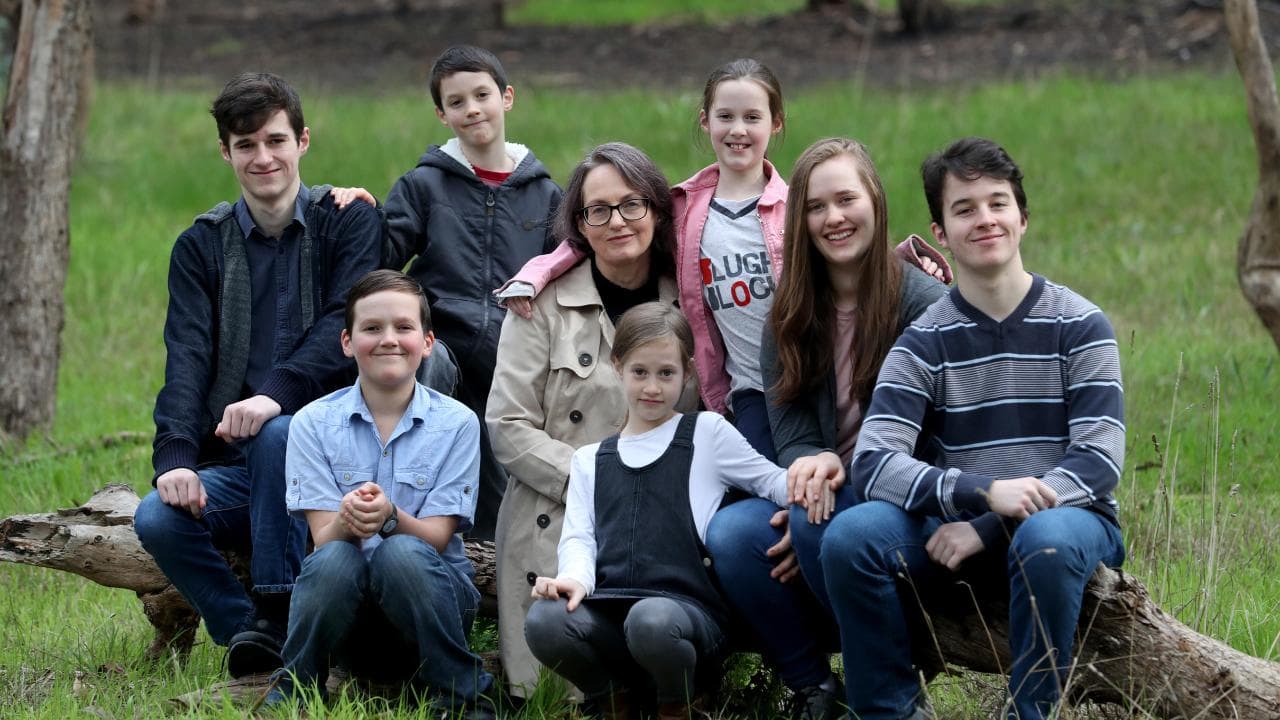
Will Kathy Clubb’s case be judged on reason rather than emotions?
October 9th marked the first day of a momentous battle over free speech in the High Court of Australia.
At the federal level, we have an ostensibly conservative government lead by an ostensibly Christian Prime Minister.
Sadly, Australia’s Attorney General Christian Porter has ordered his department to join with the States in defending abortion mill buffer zone laws in the High Court case involving Kathy Clubb and Graham Preston.
In 2017, Ms Clubb, a pro-life activist and mother of 13, was found guilty in the Melbourne Magistrate’s Court of breaking the law when she offered a leaflet to a couple about to enter an abortion facility on Wellington Parade in Melbourne.
The magistrate stated: “There is no evidence of duress or violence of any kind. The engagement between the Accused and the couple is brief and appears polite.” Despite this, the magistrate found her guilty and fined her $5000.
Ms Clubb said in an October 8 media release: “Our founding fathers intended that Australian citizens would be free to express their opinion on political matters, to act in accordance with their religious convictions and to defend human life. This legal challenge is all about protecting those rights. The outcome of this case will be very important for all Australians and not only for the pro-life community. It’s crucial that everyone – even those with whom we disagree – is free to dissent from popular opinion. We believe that the public and politicians must be free to hear the truth about abortion, rather than being swayed by a fashionable narrative. And we also want to secure freedom for women in crisis who may feel forced to abort their children because they think they have no other option.”
Ms Clubb’s counsel Guy Reynolds submitted to the High Court that “avoidance of psychiatric harm” is an important aim but “the avoidance of hurt feelings is not”, arguing that criticism and “the resultant loss of dignity” are “inherent in political speech”.
Mr Reynolds compared anti-abortion views that may harm the dignity of women seeking abortion to “criticism of bankers” or “criticism of men by feminists” as “part and parcel” of political speech.
In their submission for an ongoing High Court appeal, Ms Clubb’s barristers outlined a number of reasons why the verdict should be overturned, the principal one being that Ms Clubb’s action was political in character and is safeguarded by the right to political discourse guaranteed by the Australian Constitution.
The barristers argue, “To change one’s mind on the ethics of abortion is apt to change the person’s mind on the politics of abortion. Further… protest on the topic of abortion outside abortion facilities is also inherently political, particularly when 20 police officers are present.” The law is also criticised for its vagueness.
“It is inherently difficult to predict whether conduct is apt to cause distress or anxiety, particularly once those concepts extend to mere discomfort,” they add.
“There is no bright line between communications which are in relation to abortion and those which are not. Is a communication seeking a vote for a political party the speaker knows to be pro-life a communication in relation to abortions?” The limits of the “Safe Access” are inherently unclear. For example, if abortions are provided at a large hospital or at a university or shopping complex, does the 150 metres extend beyond the limits of the hospital or just the building or room where the abortions are provided?
The submission gives a series of prohibitions under this law which burden the freedom of political communication.
The prohibition applies:
• To any communication relating to abortion that is able to be seen or heard (whether or not it is in fact seen or heard);
• Whether or not the recipient consents.
• Where abortions are administered by way of a drug, which includes private residences;
• Whether or not distress or anxiety is in fact caused, or intended;
• To communications by Members of Parliament and during election periods and referendums;
• Where the communicator is seeking to discourage a person from obtaining an unlawful abortion.
Kathy’s barristers ultimately argue: “What the law does, in fact, is to burden one side of the abortion debate more than the other. It discriminates, and it distorts political communication. And it does so to a viewpoint that is properly described as a minority viewpoint.”
What is the evidence of harms suffered by people who look at a pamphlet that provides information about unborn people?
The below document examines the harm evidence given to the High Court in affidavits from Dr Goldstone, a medical doctor, and Dr Allanson, a psychologist, who work for abortion clinics.
This article concludes that the evidence has "substantial limitations" and that it may be difficult for the Court to rely on this evidence in assessing the extent to which individuals communicating outside abortion clinics may harm, or even help, women and others accessing the premises.
Here are some quotes from the paper:
"Failing to take account of the possible differences in the impact of such various types of conduct may lead to the conclusion that the presence of all individuals outside abortion premises is equally likely to cause harm to patients or employees of the premises.
"Such a conclusion is likely to be false considering that conduct such as respectful offers of assistance may not produce any harm and may even help women considering abortions to avoid harm.
"For example, some women may experience adverse mental health consequences from abortions that they may have avoided if they had been provided with support that would have allowed them to continue with their pregnancy.[v] More precise studies that account for the variability of conduct outside abortion clinics may indicate that broadly operating laws such as those that exist in Victoria and Tasmania may harm some persons, especially women considering abortion, and that more nuanced laws are required to ensure that at least respectful offers of assistance remain lawful.
"A further problem is that any medical procedure can be an adverse emotional experience for patients due to a range of factors such as the pain experienced from the medical condition, the health risks involved in the procedure, patient perception of vulnerability and the loss of privacy. Abortion may be a particularly emotional experience for patients or employees of clinics when compared to other procedures due to the nature of the procedure, the patient’s perception of the significance of the procedure, the possibility that the patient is being coerced to undergo the abortion by third parties, and the substantial community disagreement regarding the ethics of abortion.[vi] Dr Goldstone, Dr Allanson and the studies relied upon by them do not address whether and, if so, to what extent, the adverse emotional states identified by them could be due to the stressful nature of any medical procedure nor to the possibility that participation in abortion as a patient or employee may be particularly stressful."
View the entire paper here: https://walta.net.au/2018/10/01/the-high-court-abortion-clinic-speech-restrictions-and-the-assessment-of-harm/
1. Surrogacy constitutes a human rights violation of the women and children involved. It commodifies children and exploits women.
2. It creates demand for a ‘perfect baby’, and selective abortion of unwanted babies (the ‘products’) is eugenics in action.
3. Women carrying surrogate babies face high risk health risks i.e. cervical cancer and ovarian cancer hyper stimulation of eggs (see more information below).
4. It may result in an increased risk of pre-mature births or children with special needs.
5. Altruistic surrogacy heralds the “choice” of the donor mother, but the baby has no choice except to be separated from their birth mother.
6. Large scale studies by Dr Paul Sullins (2016) and Dr Mark Regnerus (2012) cast strong doubt on claims of no differences between same-sex parents and opposite-sex parents. ‘No difference’ studies are based on small, non-random samples, which generally ensure a no difference result.
7. Government data shows no single female has applied for surrogacy in WA since legalised in 2008. Instead of allowing surrogacy for single men, surrogacy for single people should be removed.
8. Children need and deserve a mother and father.
You could remind MPs that a convicted child sex offender in WA ordered a child via surrogacy in Thailand. His sperm donation became twin children, a girl and ‘Baby Gammy’, a boy with Down syndrome who was abandoned by his father. Thanks to the bravery of his birthmother, Chanbua Pattharamon, Gammy is now living a happy life in Thailand, whereas his twin sister Pipah was ordered by an Australian judge to live with her ‘father’ and his wife in Western Australia. This 2014 case ended commercial surrogacy in Thailand, but the exchange of money was not material to the tragedy of the case.
Why Oppose Surrogacy?
Stop Surrogacy Now is a resounding ‘No!’ Whether for love or for money, the fact remains that surrogacy is the commissioning of a baby by affluent heterosexual or homosexual couples using a woman of usually lower economic standing as a baby incubator - a breeder.
Surrogacy is dangerous
The surrogate mother - often callously called a “gestational carrier” - is required to submit to a three to four week drug regimen in order to prepare her womb for pregnancy. These drugs can make her very sick, possibly with long-term effects.
In addition to the battery of prenatal tests she must undergo, there is also the risk of pregnancy complications - including ovarian torsion, ovarian cysts, chronic pelvic pain, premature menopause, loss of fertility, reproductive cancers, blood clots, kidney disease, stroke and, in some cases, death.
Women who become pregnant with eggs from another woman are at higher risk for pre-eclampsia and high blood pressure. The health risks are even worse for women who donate eggs, with the increased prevalence of Ovarian Hyperstimulation Syndrome (OHSS) and ovarian cancer many years later. (I’d commend the eye-opening documentary Eggsploitation for stories of women hurt by egg donation.)
What is demanded of a surrogate mother is the manufacture of a perfect baby - this is eugenics in action. If the product is deemed flawed, she will be pressured to consent to an abortion, selective reduction or foetal surgery in the womb.
At birth, the baby is most often removed by caesarean section, with the birth mother frequently not given the chance to see her child. What is left is a woman with milk in her breasts but nothing in her arms. The attention that for nine months had been lavished on the woman - who is called a hero, an angel, a giver of life by the commissioning couple in an altruistic surrogacy arrangement - in the great majority of cases disappears very quickly. Once the job is done, and the baby handed over, the birth mother, in whose body remain cells of her child for decades, is left to her own devices.
Many surrogate mothers say it was their “choice.” What sort of choice is it when one cannot predict the effect of the drugs, the pregnancy and the birth on the woman? And what sort of choice is it for the baby? Did she or he really “choose” to be separated from their birth mother?
Surrogacy is reproductive slavery; a violation of the human rights of both the birth mother and her offspring.
Compared to the United States, India, Ukraine and Mexico, Australia is still in the fortunate position of prohibiting commercial surrogacy, and altruistic surrogacy is well regulated in all states except the Northern Territory which has no laws. Moreover, the actual number of babies born through altruistic surrogacy arrangements is negligible.
The National Perinatal Epidemiology and Statistics Unit (NPESU) publishes yearly reports that include data supplied by 37 fertility centres in Australia and New Zealand. The latest available 2011 and 2012 reports state: “There were 177 gestational surrogacy cycles in 2011, including 131 gestational carrier cycles and 46 cycles undertaken by intended parents. Among the 131 gestational carrier cycles, 34 (26.0%) resulted in a clinical pregnancy and 21 (16.0%) resulted in a delivery. Of all 23 babies born to gestational carriers (21 singletons and one set of twins), 22 were liveborn and one singleton’s outcome was unknown.”
Would this change if Australia legalised commercial surrogacy in future? Perhaps unemployed women might think that $30-40,000 is worth the risk and discomfort of pregnancy; or that they could always resort to selling their eggs four, five, six times for $5,000 per batch. For the commissioning parents - euphemistically called “intended parents” - the price would be much higher because the surrogacy industry’s lawyers, counsellors, surrogacy brokers and, last but not least, the IVF clinics who delight in this new business opportunity, would all demand their share. The government too might be eager to collect taxes from the various players involved in commercial surrogacy - surrogates and egg donors included. A $100,000 price tag for a baby can easily be countenanced. And because of the high failure rates, repeat pregnancies make the procedure harder for the birth mother and more expensive for the buyers.
It was only in 2013 that then Prime Minister Julia Gillard delivered a heartfelt apology to mothers and their children who were forcibly removed for adoption in the 1960s and 70s. We would do well to remember the trauma and depth of feeling this apology elicited in discussions about surrogacy, which is the intentional removal of a child from his or her birth mother. Do we really want to find ourselves in the position forty years hence of having to deliver yet another apology to children who were harmed by surrogacy.
The first order of business would be to lower the demand for all forms of surrogacy, including so-called altruistic surrogacy. There is no right to a child. A deep desire for a child does not justify the narcissistic exploitation of another woman’s body and soul, as well as her health - two women, in fact, if an egg donor is also needed.
People who long for children should be encouraged to look to permanent care arrangements for the thousands of existing children in Australia who need a loving home. Having a baby with your own genes is not a prerequisite: it is love and dedication that counts.
Children are not commodities to be bought and sold, and women are not containers to be used as baby makers and then discarded. Let’s stop surrogacy now.

"Mechanized pornography" - a direct consequence of the Darwinian belief that humans are "robot vehicles blindly programmed"
Nancy Pearcey wrote in her newly released book Love Thy Body: "The next step, some say, is robotic sex (with sex dolls). Futurists predict that in ten years sex robots will become more popular than porn. The first sex doll brothel has already opened in Barcelona, Spain. A materialist philosophy has been teaching people that they are merely complex mechanisms, and now we are seeing the logical outcome—the substitution of machines for real persons. The ultimate depersonalization."
London-based AI (artificial intelligence) researcher David Levy predicted in his 2007 book Love and Sex with Robots that humans would have sex, fall in love and even marry robots by 2050.
“I don’t see anything wrong in using a sex robot to provide sexual satisfaction to people who can’t achieve it in relationships with other humans. It’s much better for lonely and miserable people than no sex at all… Sex robots are just providing an alternative," Levy wrote.
Dr. Kathleen Richardson, Professor of Ethics and Culture of Robots and AI, wrote in response to Levy’s idea:
“…Levy also proposes that sex robots could help to reduce prostitution. However, studies have found that the introduction of new technology supports and contributes to the expansion of the sex industry. … Prostitution and pornography production also rises with the growth of the internet. In 1990, 5.6 percent of men reported paying for sex in their lifetime, by 2000, this had increased to 8.8 percent.
What really happens is that girls and women increasingly feel pressured to be a real-life embodiment of what boys and men have learned from watching porn, “adopting exaggerated roles and behaviors and providing their bodies as mere sex aids. Growing up in today’s porn culture, girls quickly learn that they are service stations for male gratification and pleasure," according to Pearcey.
World leading athiest Richard Dawkins, argues on the basis of Darwinian, humanistic thought that humans are merely “survival machines—robot vehicles blindly programmed” to preserve their genes.
So if girls are already conditioned in this hyper sex-saturated culture to believe they are to be used for male sexual gratification by default, then a culture that lives on mechanized sex is just that one step further.
For years, ever since the introduction of Darwinian evolution being taught in schools and broadcast mediums, people of all ages have been programmed to believe that humans are nothing more than moist robots. The advent of robotised sex is thus a completely logical and non-surprising outcome.
"But how did it become possible that some people would prefer a mechanized doll to a real person?" Pearcey asks the question all of us want the answer to.
"The answer is that sex has been steadily de-personalized. Start with the hookup culture: It rests on the assumption that sex can be purely physical -- cut off from the whole person, without any hint of love or commitment.
"Young people know the script all too well. In my new book Love Thy Body, I include several heart-wrenching quotes from college students -- like Alicia, who says, “Hookups are very scripted.... You learn to turn everything off except your body and make yourself emotionally invulnerable.
"Another student told Rolling Stone magazine the mistake people make is they “assume there are two very distinct elements in a relationship, one emotional and one sexual, and they pretend like there are clean lines between them.” In other words, they treat sex as a strictly physical act isolated from the rich inner life of the whole person.
"Critics of the hookup scene often claim it gives sex too much importance, but in reality it gives sex too little importance. It treats the body as nothing but a physical organism driven by physical urge and instincts.
"No wonder it is creating a trail of wounded people. They are trying to live out a view of sexuality that does not fit who they really are."
Melissa Farley, founder of San Francisco based Prostitution Research and Education, says robots function as “mechanized pornography.” Everything we know about the harms of pornography—how it teaches men to dehumanise and degrade women—“applies ten times more to these mechanised females.”
In the U.S., Yuval Gavriel, founder of “Kinky S Dolls,” is trying to skirt legal regulations by claiming his company is not a robot brothel (which currently exist in Europe and Japan) but a “showroom.” Customers can rent the dolls, test them on the premises, and decide whether to buy one. Half hour in a private room with a sex robot costs $60.
Customers may also purchase a robot, but for most people the cost is prohibitive: from $2,500 to $10,000 for a high-end doll with artificial intelligence that can talk and respond to touch. Realistically, most customers will “rent” the dolls.
Some argue that sex robots will reduce crime (such as human trafficking), as potential offenders take out their fantasies on dolls instead of real people. But such opinions are “not borne out by evidence,” writes Dr Richardson.
"There are numerous sexual artificial substitutes already available, RealDolls, vibrators, blow-up dolls etc., If an artificial substitute reduced the need to buy sex, there would be a reduction in prostitution but no such correlation is found."
In 2017 the House of Representatives passed H.R. 4655 named the CREEPER Act outlawing the transportation, owning or selling of child sex dolls in the U.S. The bill is founded on the notion that child-like sex dolls do not deter abusers from harming children. These dolls normalize the acts of pedophilia and legitimize the urge to sexualize children.
H.R. 4655 states, “The dolls and robots are intrinsically related to abuse of minors, and they cause the exploitation, objectification, abuse, and rape of minors.”
Not only will the robots fail to subdue the demand for consumerized humans, but they are also a place of rehearsal for horrifically extreme fantasies of rape, abuse, torture, pedophilia, and other deviant harm.
"Once an abuser tires of practicing on a doll, it's a small step to move on to a child," bill sponsor Rep. Dan Donovan said, while fellow House Republican Bob Goodlatte noted the child sex dolls "desensitize the user, causing him to engage in sicker and sicker behavior."
A release from Donovan's office reported the UK seized 128 of the dolls, and 85% of the men who imported them were found to have child porn. Goodlatte noted the dolls not only can be made to look like a specific child, they can also be given certain facial expressions, like fear or sadness.
On 9 October 2018, the High Court of Australia will consider the constitutionality of Victorian and Tasmanian laws prohibiting protesting, offers of assistance and other types of communication around abortion clinics.
Those supporting the laws claim that they are needed considering the significant harm that may be caused by this conduct. There are, however, substantial problems with the medical evidence provided to the High Court in support of such claims.
This article by Dr Joseph Turner, Debbie Garratt and Dr Simon McCaffrey critiques this evidence and highlights key questions that remain unaddressed by the expert medical opinion.
This article concludes that the evidence has "substantial limitations" and that it may be difficult for the Court to rely on this evidence in assessing the extent to which individuals communicating outside abortion clinics may harm, or even help, women and others accessing the premises.
Here are some quotes from the paper:
"Failing to take account of the possible differences in the impact of such various types of conduct may lead to the conclusion that the presence of all individuals outside abortion premises is equally likely to cause harm to patients or employees of the premises.
"Such a conclusion is likely to be false considering that conduct such as respectful offers of assistance may not produce any harm and may even help women considering abortions to avoid harm.
"For example, some women may experience adverse mental health consequences from abortions that they may have avoided if they had been provided with support that would have allowed them to continue with their pregnancy.[v] More precise studies that account for the variability of conduct outside abortion clinics may indicate that broadly operating laws such as those that exist in Victoria and Tasmania may harm some persons, especially women considering abortion, and that more nuanced laws are required to ensure that at least respectful offers of assistance remain lawful.
"A further problem is that any medical procedure can be an adverse emotional experience for patients due to a range of factors such as the pain experienced from the medical condition, the health risks involved in the procedure, patient perception of vulnerability and the loss of privacy. Abortion may be a particularly emotional experience for patients or employees of clinics when compared to other procedures due to the nature of the procedure, the patient’s perception of the significance of the procedure, the possibility that the patient is being coerced to undergo the abortion by third parties, and the substantial community disagreement regarding the ethics of abortion.[vi] Dr Goldstone, Dr Allanson and the studies relied upon by them do not address whether and, if so, to what extent, the adverse emotional states identified by them could be due to the stressful nature of any medical procedure nor to the possibility that participation in abortion as a patient or employee may be particularly stressful."
View the entire paper here: https://walta.net.au/2018/10/01/the-high-court-abortion-clinic-speech-restrictions-and-the-assessment-of-harm/
David Robertson, a Christian minister in Scotland, has reported Scotland Police and the Scottish Government for committing a hate crime against Christians.
You state that “A hate incident is any incident that is not a criminal offence, but something which is perceived by the victim or any other person to be motivated by hate or prejudice.” By your own criteria your posters, especially the one on religion is a hate incident. I perceive it as being motivated by hate and prejudice.
Why? In my day-to-day life I experience a great deal of anti-Christian prejudice, fuelled by ignorance and prejudice. Your poster will just add to that. You imply that it is religious people who are responsible for what you call homophobia and transphobia (although you don’t define what you mean by these terms – is being opposed to SSM ‘homophobia’? Is believing that a woman is a ‘female adult human’ transphobia? By not defining your terms you have of course left room for people to claim your support for anything that they determine is ‘phobic’).
This comes after the Scottish Government in partnership with the Scottish Police has launched a new campaign deliberately targeting Christians in an effort to tackle the seemingly growing problem of “hate crime” in the country.
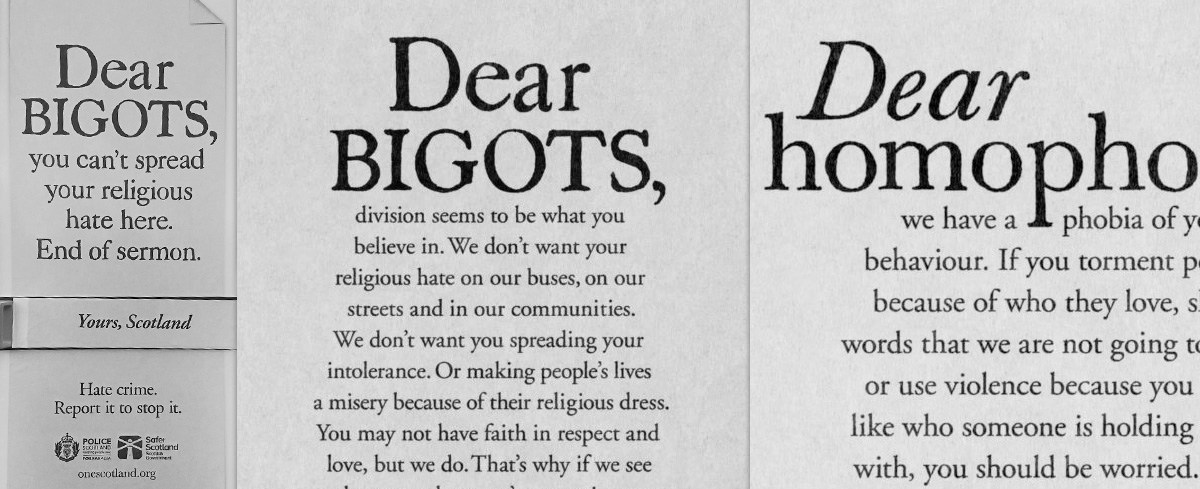
The ‘Letters from Scotland’ campaign (which is taxpayer funded) include letters printed on posters to bigots, transphobes, and homophobes. The posters urge citizens to report any “religious hate” they may see or hear.
One poster reads:
"Dear bigots, division seems to be what you believe in. We don’t want your religious hate on our buses, on our streets and in our communities. We don’t want you spreading your intolerance. Or making people’s lives a misery because of their religious dress. You may not have faith in respect and love, but we do. That’s why if we see or hear your hate, we’re reporting you. End of sermon. Yours, Scotland."
This message reveals a tyrranical sentiment towards anyone who opposes the status quo or so much as even dares to hold differing opinions. This is further reflected in a statement by Chief Superintendent John McKenzie:
“Police Scotland treats all hate-related crimes and incidents as a priority," he announced.
“It is recognised that hate-related crimes and incidents pose a significant threat to victims, their friends, families and wider communities, and the potential impact of such crimes cannot be underestimated.
“We continue to work tirelessly to ensure we respond to all reports of hate crime and I would encourage anyone who has been a victim of, or witnessed, a hate crime to report it.”
As Robertson, who is also the author of theweeflea.com, rightly points out:
They are selective – Its only certain groups that are mentioned. Look at what they leave out. What about those of us who are Christians who are regularly mocked and abused in the media, in our schools and on the streets? What about English people in Scotland? What about the disabled? Or many, many other groups? Why do they only pick on these select groups?
They are intimidatory – It is not the job of the police to police our thoughts and hearts. They can have no idea what we do or do not hate or love. Their responsibility is to deal with crimes that are committed. They do not have the time, money or ability to deal with our thoughts. But it seems they are going to try. The new State morality is going to be imposed through education and enforced by the State police – welcome to modern Scotland – the Saudi Arabia of Secularism.
They are self-contradictory – A poster which is designed to combat hate – spreads hate. Imagine a poster which said – Dear bigots, you can’t spread your homosexual hatred here!” . You would be arrested immediately for putting that up. But now the police and the Scottish government are putting up a poster which incites hatred – by implying that it is religion that is to blame. I get enough hatred in schools, Universities, the media and online, without the government and police encouraging it!
Furthermore, it must be noted that campaigns such as this one set a dangerous precedent concerning free speech and the right to express one's views without harassment or penalty.
FamilyVoice Australia upholds Christian values and the family: permanence of marriage, sanctity of human life, primacy of parenthood and limited government.
Subscribe to our award-winning publications!
Don't miss out on quality research and news that will equip you to face the culture wars.
Society is suffering from ‘progressive’ ideas.
Join the growing movement of young people daring to be counter-cultural.